The artificial intelligence boom has long been pitched as a transformative force that would boost productivity and eventually lower costs across the economy.
But this week, investors were confronted with a less discussed consequence of the AI race: higher prices.
Apple and Microsoft both announced product price increases on Thursday, citing soaring costs for memory and storage technologies that have become increasingly scarce as technology giants pour hundreds of billions of dollars into building AI infrastructure.
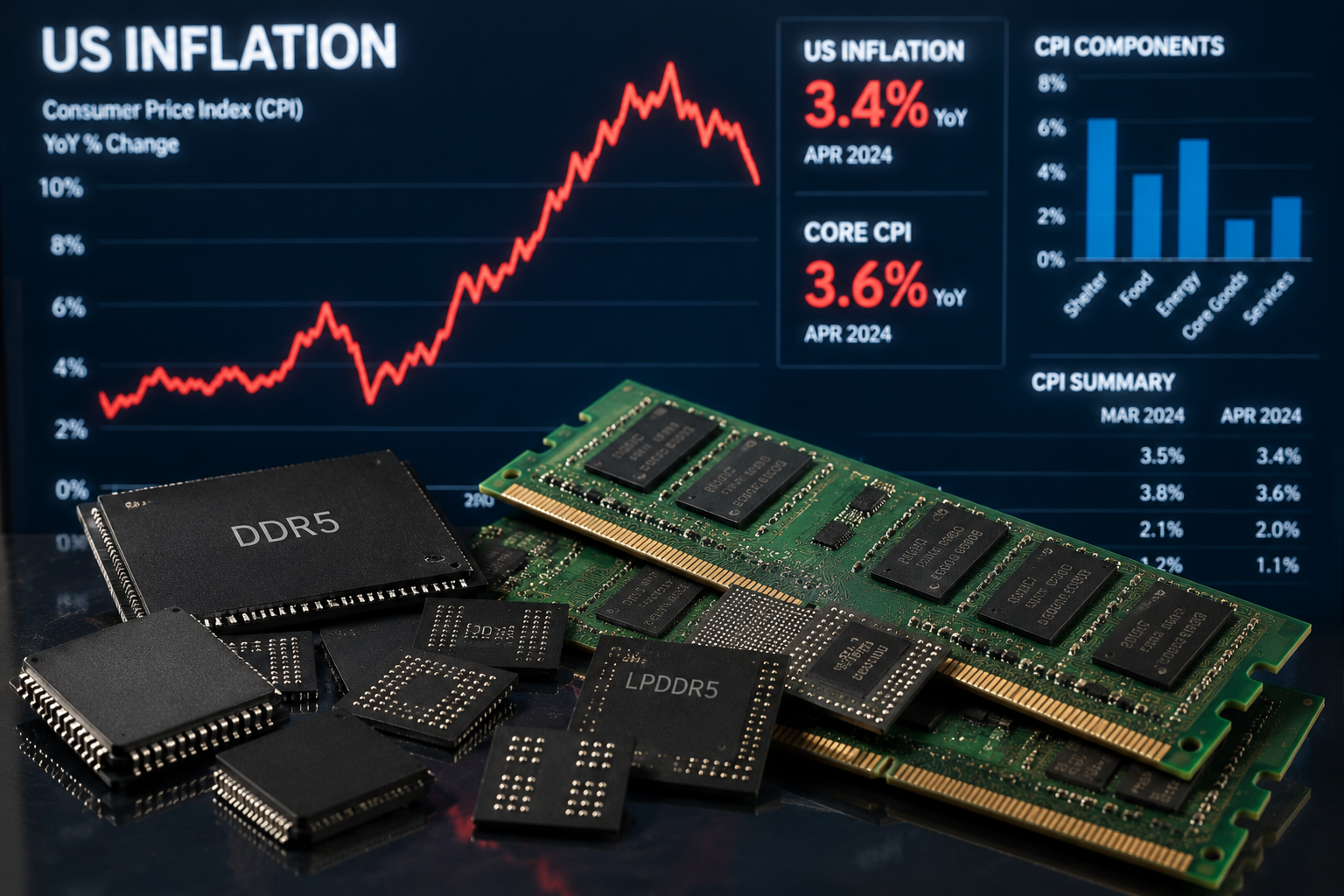
The moves reinforced growing concerns that, at least in the short term, AI may prove inflationary rather than disinflationary.
“Apple and Microsoft’s price rises have struck at the market’s fear of inflation, raising worries that, far from being deflationary, the AI boom might be inflationary, particularly for the hard-pressed consumer, hurting rather than aiding economic growth,” Chris Beauchamp, chief market analyst at IG, said.
Memory shortages hit consumer electronics
Apple raised prices on several MacBook and iPad models by between $100 and $300, though it left iPhone prices unchanged.
“The rapid expansion of AI data centers has created an extraordinary surge in demand for memory and storage. We have never seen a component price increase this much, this quickly,” Apple said in a statement.
The company added that it had “reached a point where we need to begin raising prices on a number of products,” while indicating that additional increases remain possible.
The market reaction was swift. Apple shares tumbled 6%, their worst single-day decline in more than a year.
Microsoft announced similar measures.
The software giant said prices of Xbox consoles would rise globally, with increases of $100 for 512-gigabyte models and $150 for one-terabyte versions effective Aug. 1.
The company also said it would discontinue its two-terabyte Xbox model.
The moves added to a growing list of technology manufacturers raising prices this year.
Dell, HP, Lenovo and Asus have all flagged higher prices, while Samsung increased prices on two variants of its Galaxy S26 smartphones in the United States by $100.
Shortage of memory chips and ‘chipflation’ fears
The price increases stem from an unprecedented shortage of memory chips.
Memory and storage components have become critical ingredients in the AI boom as hyperscalers race to build increasingly powerful data centres.
Suppliers have shifted production toward high-bandwidth memory chips used in AI servers, leaving consumer electronics manufacturers scrambling for supplies.
“The four largest US technology companies are forecast to spend $725 billion on data centers and AI equipment in 2026 alone. That level of demand for memory chips has created a shortage the supply chain cannot keep pace with,” said James Bull at RSM UK.
Bull said it had become increasingly evident that the costs of building the AI economy were being passed on to consumers and potentially to the broader inflation outlook.
Morgan Stanley analysts warned earlier this month that soaring memory prices could trigger “chipflation” across industries.
The brokerage said memory chip prices had risen six-fold over the past year.
“What began as an AI infrastructure bottleneck is now spreading into hardware margins, device affordability, cloud costs, inflation and policy,” the bank wrote in a note.
Areas where AI infrastructure is creating new inflation pressures
Some economists believe the inflationary impact of AI extends beyond semiconductors.
According to an April note by JPMorgan Asset Management’s Chief Global Strategist David Kelly, the enormous spending wave tied to AI development is likely to be inflationary in the near term rather than deflationary because demand is hitting the economy well before productivity gains materialise.
Kelly acknowledged that rising memory-chip prices are one channel through which AI investment could feed into higher prices, but said they do not yet represent a major source of economy-wide inflation.
Instead, he pointed to other emerging pressures. One of the clearest examples is electricity demand.
“One aspect of this demand is spending on electricity. After more than a decade of no growth, US electricity production rose by 2.5% in 2024, 2.4% in 2025 and was up by 3.0% year-over-year in March of 2026,” he said, noting that much of the increase was driven by data centre consumption and the growing use of AI models for training and inference.
Kelly said this likely contributed to a 4.6% year-over-year increase in consumer electricity prices in March.
However, because electricity carries a weight of only about 2.5% in the consumer price index basket, higher power costs accounted for just 0.1 percentage point of March’s 3.3% annual rise in headline inflation.
The construction boom linked to AI data centres is also creating labour pressures.
Construction workers saw wages rise 4.3% year-over-year in March, outpacing the 3.5% increase recorded across the broader private sector.
However, Kelly said this acceleration was probably driven more by labour shortages than by AI itself.
The total number of US construction workers increased only 0.7% over the past year, partly reflecting a sharp reversal in immigration trends in a sector that has historically relied heavily on immigrant labour.
AI productivity gains could eventually ease inflation, economists say
Kelly, however, said it was unlikely that most corporations had so far realised significant cost savings from deploying the latest AI models and even less likely that any savings had been passed on to consumers.
“There is a small but growing number of layoff announcements explicitly attributed to AI and there are some signs of diminished hiring of entry-level workers in the most AI-exposed industries,” he said.
He added that fears that AI will “take your job” could also be making workers more cautious, with economywide year-over-year wage growth falling to an almost five-year low in March.
However, more recent data from global outplacement firm Challenger, Gray & Christmas suggests AI’s impact on employment is becoming more pronounced, though.
US-based employers announced 97,006 job cuts in May, with artificial intelligence accounting for roughly 40% of all layoffs announced during the month.
It marked the third consecutive month in which AI was the leading reason cited for job reductions.
“Despite this labor market ‘scare’ effect, however, it does appear that AI is, on balance, adding slightly to inflation in the short run, although it will be far from the most important inflation driver. If this continues to be the case, over say, the next two years, then this alone would negate the idea that a disinflationary impulse from AI supports the need for short-term interest rate cuts,” Kelly said.
He expects AI to become a powerful disinflationary force over the longer term as productivity gains begin to emerge and spread across the economy.
Goldman Sachs has echoed that assessment, saying AI is currently adding to inflationary pressures even though it should ultimately lower production costs and lift economic growth.
“We expect artificial intelligence to deliver large productivity gains over the next several years, boosting the economy’s potential growth rate and putting downward pressure on production costs. So far, however, AI is boosting US inflation,” Goldman Sachs economists wrote last month.
The post Apple and Microsoft hike prices due to memory: is AI becoming an inflation machine? appeared first on Invezz